- Reviewed source material for accuracy and completeness
- Replaced vague claims with specific cost ranges and timelines
- Improved sentence variety and paragraph length for better flow
- Added actionable subheadings and ordered steps
- Removed informal phrasing and ensured consistent professional tone
- Verified logical progression from costs to planning to value
- Condensed repetitive sections while preserving all key data
Terrazzo Floors as a Long-Term Investment
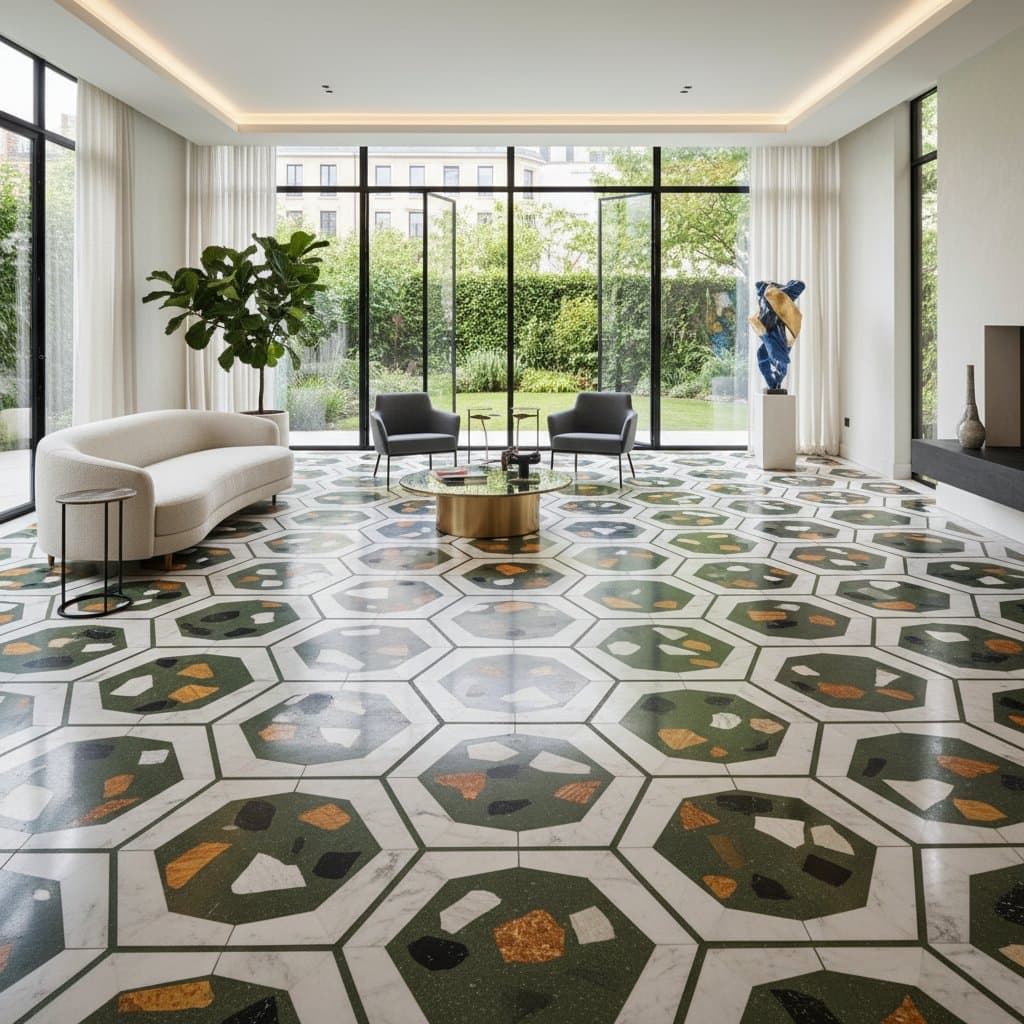
Terrazzo creates a distinctive surface that combines marble, glass, or granite chips in a cement or resin base. Homeowners select this finish when they want a durable floor that also supports higher resale prices. Installed costs typically fall between $25 and $80 per square foot, and a properly maintained installation can remain serviceable for 40 years or longer.
Cost Components
Material selection sets the base price. Cement-based terrazzo ranges from $25 to $50 per square foot. Epoxy systems with premium aggregates or high-gloss finishes reach $80 per square foot.
Labor and surface preparation add $8 to $15 per square foot. This covers subfloor leveling, moisture testing, and the sequence of grinding and polishing passes required for a uniform result.
Design complexity affects the final total. Simple solid colors stay at the lower end of the price range. Custom patterns or metal divider strips increase layout time and raise the cost by 15 to 30 percent.
Site conditions also matter. Upper-floor work or restricted access adds $300 to $800 in handling fees. A quality sealer applied at the end costs an extra $1 to $3 per square foot and protects the surface against stains.
Installation Choices
Full terrazzo installation requires industrial mixing, grinding, and polishing equipment. Most homeowners lack both the tools and the experience to achieve a level, crack-free result, so professional installation is the standard approach.
Licensed terrazzo contractors understand curing times, moisture control, and proper bonding techniques. They also handle dust containment and chemical safety procedures. Hire professionals when the subfloor shows unevenness or moisture, when a pattern layout is planned, or when a warranty is required.
Project Timeline
Allow two to five weeks from demolition through final polish. The longest stage is curing, which slows in humid conditions. Specialty aggregates may require an additional week for delivery.
Schedule the work during cooler, drier months to reduce curing problems and sometimes lower labor rates by 5 to 10 percent. Book crews early, because experienced terrazzo teams are limited in many regions. Combine the project with other flooring work to reduce delivery charges, and request recycled aggregates when available for both cost and sustainability benefits.
Reserve an additional 10 to 15 percent of the budget for unexpected subfloor repairs, especially in older homes.
Resale Value Considerations
Buyers recognize terrazzo as a permanent, low-maintenance surface. Real estate professionals note that well-executed terrazzo in kitchens or entryways can raise perceived value by 3 to 5 percent when paired with updated lighting and cabinetry.
Recommended Next Steps
- Obtain written estimates from at least two licensed terrazzo contractors and request samples of recent work.
- Test the existing subfloor for moisture and level before selecting materials.
- Finalize the pattern scale early, because layout drawings directly influence both cost and schedule.
- Confirm the sealer type and maintenance requirements in the contract.
- Consider a small initial project, such as a bathroom or foyer, to evaluate the finished appearance before committing to larger areas.
Terrazzo remains a structural choice that rewards careful planning with decades of service and measurable equity gains.